Friday, October 31, 2008

Taking the GRE General Test

I've been putting the GRE off for years... so I finally scheduled myself to take it (and paid the $$$), hoping that the pressure of the deadline would motivate me to study.

That's not exactly how it worked out. I ended up only studying the night before the test, using the ETS Test Prep CD that I received from ETS after registering for the GRE. Even so, I managed a 660 on the Verbal portion, and an 800 on the Quantitative.

The good thing about the prep software is that the interface looks just like the real one on the computer-based test, so you should definitely take all of the practice tests that are included on the CD.


SOME ADVICE

Stuff you should know about taking the computer-based test:
  1. You must answer every question as it appears-- you cannot skip questions and come back later. This significantly alters your test strategy, if you have taken previous standardized tests on paper.
  2. WATCH THE CLOCK during your essay portion. I was still re-typing a sentence in my conclusion paragraph when the screen went blank and then told me my time was up.
  3. Bring an energy bar (I prefer BALANCE Bars) and leave it in your locker for a snack during your 10-minute break.

Stuff to know for the Verbal portion:
  1. How to comprehend what you read.
  2. Lots of vocabulary. The analogies are the hardest part, since you need to understand all the possible nuanced meanings of the words.
Basically, either you know this stuff or you don't. If you don't, then you need to set aside several months to improve your reading comprehension and your vocab.


Stuff you should learn, understand, and memorize before the test:
  1. The Pythagorean Theorem. Several of the quantitative questions ask you to solve problems which involve right triangles.
  2. The formulas for both the area and the circumference of a circle.
  3. Remember that the ratio of a square's side to its diagonal is 1 to the square root of 2 (1.414).
  4. The area of a right triangle is its base times its height, DIVIDED BY TWO.
  5. Be able to solve a system of linear or quadratic equations.

General strategies:
  1. DO PRACTICE TESTS. These help you assess your current state, and get you accustomed to the format.
  2. GO TO BED EARLY. In the final 24 hours prior to the test, a good night's sleep is worth way more than any more studying.
  3. DON'T FREAK OUT. If you know basic mathematics and some properties, you can probably figure out most of the answers. I solved one problem where they wanted me to compute a value in a series the right way, but I just did it by hand, working out each term individually. I got it right.

Good luck. and remember-- you can always take it again.

Sunday, October 5, 2008

My First Publication

It's not in a journal, and it is not a paper, but it is cite-able. The Anthropology Review Database, hosted at the University of Buffalo, has published my book review of A Space Syntax Analysis of Arroyo Hondo Pueblo, New Mexico: Community Formation in the Northern Rio Grande.

I read this book as part of my research into neighborhood formation in pre-state settlements last semester. Another grad student in the seminar I was taking brought the ARD to our attention as a great source of Anthropological book reviews, and I discovered that they were looking for a review of this book (they have a large list of books and films for which they desire a review).

Here's the abstract of my review to give you an idea of what the book is about:

Using the large body of research collected from Arroyo Hondo pueblo during the 1970s, Jason Shapiro employs space syntax analysis, a method initially developed with modern architecture in mind, to analyze the settlement and subsequent resettlement of this 14th century community in the Rio Grande valley.

Take a look, it's short (but good).


REFERENCES:

Shapiro, Jason S.
2005 A Space Syntax Analysis of Arroyo Hondo Pueblo, New Mexico: Community Formation in the Northern Rio Grande. Santa Fe, New Mexico: School of American Research Press.

Wren, Paul
2008 Review of A Space Syntax Analysis of Arroyo Hondo Pueblo, New Mexico: Community Formation in the Northern Rio Grande. Anthropology Review Database. September 01. Electronic document, http://wings.buffalo.edu/ARD/cgi/showme.cgi?keycode=3256, accessed October 5, 2008.

Thursday, September 11, 2008

September: Commuting to Tucson

I still haven't recovered from the summer.

Taking two semesters of Spanish in only 10 weeks (with an Urban Politics course thrown in for good measure) meant I missed the whole thing!

I succeeded, I suppose, given that received a grade of "A" in each of the three courses. Did I learn much Spanish? Not really.

It is already the third week of the Fall semester, and I am behind, behind, BEHIND. Spanish 201 is much harder than I thought it would be, and I have yet to finish the weekly reading in Dr. Inomata's Mesoamerican Archaeology course at the U of A.

Here's a tip on learning Spanish: DRILL. Make flashcards of nouns, verbs, and specific conjugations. Do them over and over and over. It's a little like multiplication tables: You just need to memorize a bunch of stuff to be successful later on.

Commuting to Tucson is no big deal. I leave the Phoenix area around lunchtime, arrive on campus early enough to sit down and review my reading (translation: DO my reading), and go to class. Afterward, I get dinner at one of the eateries near campus and begin the drive home around 6:30 pm. I'm home before 8:30, and take the rest of the day off from school worries.

The drive is a bit boring, but I have a Sirius satellite radio (150 stations and nothing much to listen to), and I also listen to a few of the Coffee Break Spanish podcasts. I really recommend these! They're useful, fun, and free.

I'll post some info on the Pre-Classic period in the Maya Lowlands when I get a chance.

Friday, June 13, 2008

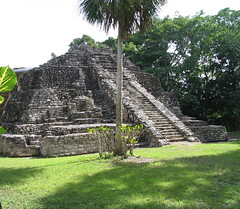
Photos of Chacchoben are up!


19 Temple 2
Originally uploaded by kactuswren
I have finally uploaded photographs of my visit to Chacchoben to my Flickr account.

Chacchoben is a Mayan ceremonial center in the Yucatan about which very little is known. Only one scholarly work has been published, and it is written in Spanish (I've requested it through inter-library loan, and I'm gonna try to decipher it!).

Visitors are allowed to see the large Temple (Temple 24), and two others nearby which are on top of a large platform (you can see the large stairway that leads to the top of the platform in my set). There is another unexcavated group of temples a short distance away that is part of the same complex.

I'm working on a personal project to pull materials together and get a better overall picture of Chacchoben, and I'll be post it it here when I do.

A Crazy Summer, followed by an Important Fall

SUMMER 2008

I'm two weeks into summer school: Spanish 101 every night of the week, and an internet course on Urban Politics. It seems that all I do is get up, go to work, go to class, go home, go to bed.

I'm taking Spanish 102 in the second 5-week session, so I will complete 11 total credit hours before the beginning of the Fall semester.

FALL 2008

Once the Fall comes, I'll be busier than ever:
It is only nine miles shorter to drive to Tucson from my house (as opposed to Flagstaff), but my wife has convinced me that the more friendly year-round weather will make it a better choice. I have already been accepted to Arizona as an unclassified Graduate student, and I've already registered.

I'm going to be taking a Mesoamerican Archaeology course from Dr. Takeshi Inomata. He is a Mayanist (he's currently doing fieldwork in Guatemala), and I think I would enjoy working with him.

Before the Fall semester is over, I will need to submit all application materials to the various graduate schools in which I'm interested. I plan to apply to the following (presented in alphabetical order, NOT the order of preference):


SPRING 2009

I still need to finish up my B.A., and I'll need to take the following courses to make this happen:
  • Spanish 202 (at ASU)
  • One more Physical Anthropology course
I only hope that Dr. Johansen is teaching ASM 246, Human Origins! Otherwise, I will end up taking a lab course such as Fossil Hominids or Primatology (takes LOTs of time), or maybe something easire such as Peopling of the World.

The big mystery, of course, is where will I be in the Fall of 2009?

Tuesday, May 27, 2008

Iron Man? I loved it.

Funny, but it took an anthropologist to write the best review of Iron Man I've read yet.

Robert Downey, Jr. was born to be Tony Stark, no doubt.

Friday, April 18, 2008

That was one busy semester

Two days ago, I turned in the term paper for Dr. Smith's grad course, Archaeology of Ancient Built Environments. I don't have an exact count, but I suspect I spent over 100 hours on the research and the writing. It's not as good as I would like it to be-- if I decide to clean it up and really finish it, I already know many of the changes I would make.

My paper, entitled "Neighborhoods in Non-urban Settlements: A Cross-cultural Comparison," used criteria originally developed to demonstrate sub-settlement groups in the Anatolian Neolithic (in Turkey) in an attempt to find neighborhoods in Native American pueblos right here in the Southwest. This will be the topic of a longer post as soon as I get the chance. I'm creating a Powerpoint slide show that may be worth posting, for those of you who are interested.

I still have another research project in the works with Dr. Martin, and I'll be finishing my data analysis very soon. More on this later.

I'm just glad I can finally get a few full nights of sleep.